Ensure you are ready for deployment when the call comes by keeping your medical certifications current and accessible. Discover why administrative readiness is just as critical as clinical skill.
In the high-stakes environment of disaster response, the difference between arriving on scene and being sidelined often comes down to administrative preparedness. As a Florida-licensed ALS EMS Agency, ERF relies on the professional readiness of our volunteers to maintain our operational capacity during emergencies. While clinical drills and field exercises are vital, the foundational step for every EMT and Paramedic is maintaining impeccable credential readiness.
The Critical Nature of Documentation
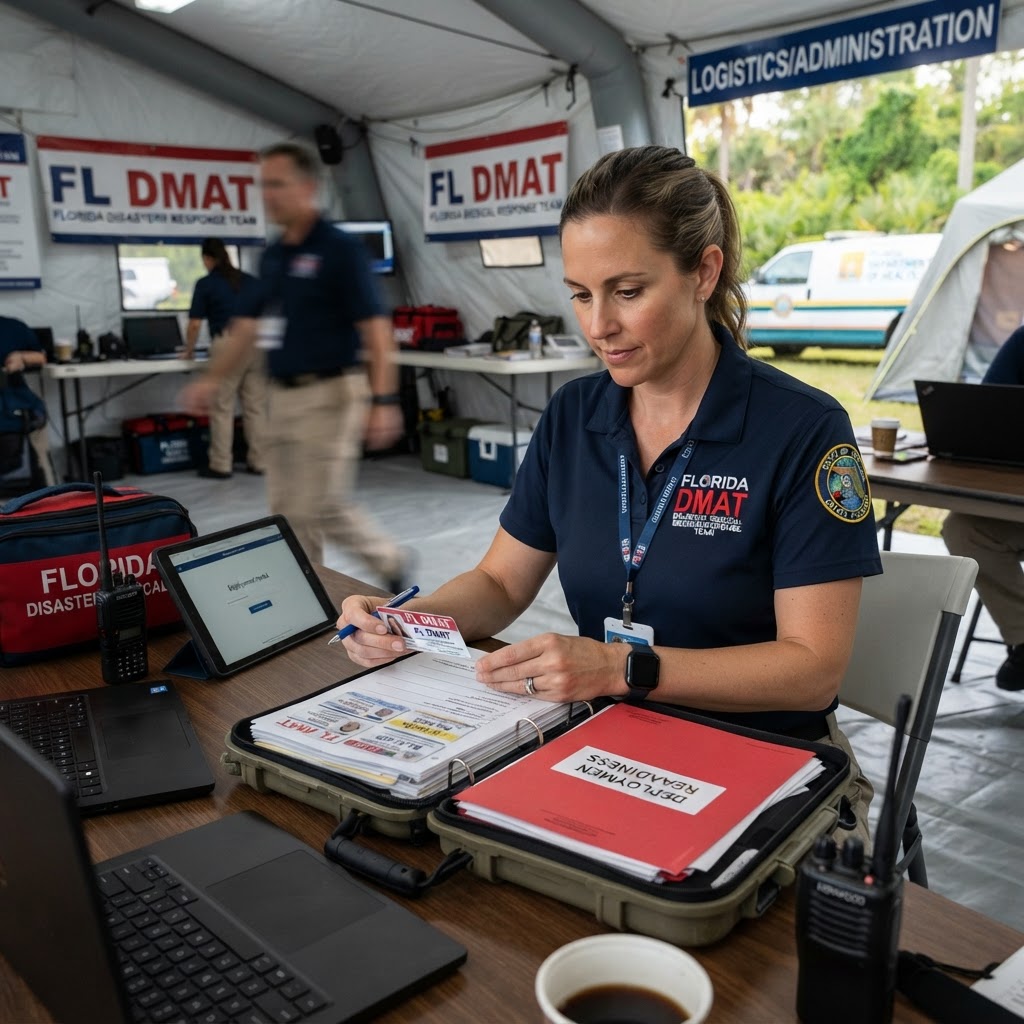
When a disaster strikes—whether it is a major hurricane or a regional public health crisis—the window for activation is often very narrow. Deploying agencies need to verify that every responder is fully licensed, insured, and current on mandatory state certifications instantly. If a responder has a lapsed card or missing documentation, they cannot be cleared for duty. Managing your credentials proactively ensures that your focus remains on patient care rather than scrambling for copies of your NREMT certificate or your Florida Department of Health license during an activation.
Digital vs. Physical Archiving
Preparation starts with how you store your professional records. Gone are the days when a single physical binder was the only requirement. Modern disaster readiness requires a hybrid approach. You should maintain a secure, cloud-based digital folder containing high-quality scans of your state license, NREMT certification, BLS/ALS cards, and government-issued identification. Simultaneously, keep a physical "go-folder" in your primary disaster kit. This ensures that even if you face power outages or connectivity issues during a deployment in Florida's challenging post-storm environment, you have immediate proof of your status ready for verification by incident command staff.
Keeping Ahead of Renewal Cycles
Many responders are caught off guard when a renewal cycle hits during the peak of Florida’s hurricane season. To mitigate this risk, create a personal notification system that alerts you three months before any license or certification expires. Take advantage of continuing education opportunities well in advance. By maintaining a buffer of several months on all certifications, you remove the stress of last-minute scrambles and ensure that you are always deployment-ready throughout the year, not just when your renewal deadline is looming.
Validating Your Training Credentials
Beyond your core medical license, many deployments require verification of specific training, such as FEMA ICS or NIMS certifications. These are frequently overlooked during the credentialing process. Treat your training certificates with the same level of importance as your clinical license. Keep a master log of all completed courses, including dates, certificates, and hours, so that you can quickly update your volunteer profile with ERF whenever a new competency is added to your repertoire.
Practical Takeaways
- Create a dedicated cloud folder for all professional licenses, certifications, and identification.
- Print hard copies of your most critical documents and keep them in a waterproof sleeve within your disaster gear.
- Set calendar reminders for at least 90 days prior to the expiration of any certification.
- Maintain a log of all completed FEMA and specialized training courses to expedite your verification process.
Why This Matters to ERF
At ERF, our commitment to providing high-quality ALS care during disasters depends on the collective readiness of our Disaster Reserve. When our responders are administratively prepared, we minimize downtime and increase our ability to integrate seamlessly with state and local emergency management systems. Your readiness is the backbone of our ability to serve Florida communities when they need us most.
Stand Ready With ERF
Florida EMTs and Paramedics can submit a Disaster Reserve interest form to be considered for activation during major emergencies, with no regular hourly requirement.
ERF is not a 911 service. In an emergency, call 911.