In the high-pressure environment of disaster response, your clinical documentation is as vital as the care you provide. Learn how to maintain standards during uncertainty.
In the world of pre-hospital emergency medicine, we are often taught that if it isn't documented, it didn't happen. While this mantra is fundamental in daily 911 operations, its importance is magnified tenfold during disaster deployments. When the landscape is chaotic and resources are strained, the accuracy and clarity of your patient care reports become the primary thread connecting the field to definitive care. For responders serving with the Emergency Responders of Florida, mastering the art of documentation under pressure is a critical component of professional readiness.
The Role of Documentation in Continuity of Care
When we deploy to support local agencies during large-scale incidents, we are often one link in a very long chain. A patient seen in a temporary field clinic may be transported to a tertiary care center three counties away. Without thorough, legible, and accurate documentation, that patient’s clinical history, administered medications, and initial assessment findings are effectively lost. Maintaining detailed records ensures that the receiving facility can provide seamless continuity of care, preventing diagnostic gaps and medication errors that occur when clinical data is missing.
Adapting to Austere Documentation Environments
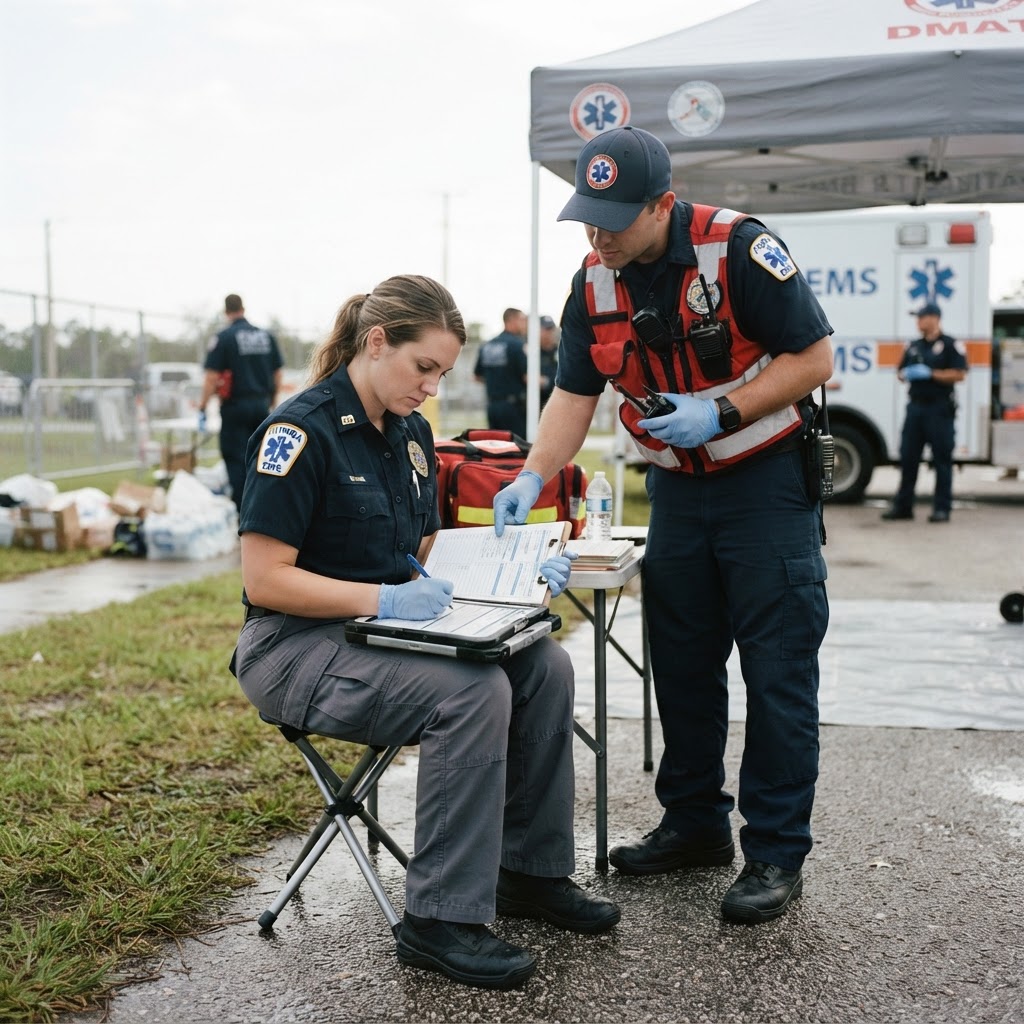
Florida's disaster environments—ranging from hurricane-impacted flood zones to extreme heat scenarios—rarely provide the quiet, climate-controlled environments we enjoy in a standard ambulance. We must be prepared to document effectively in challenging conditions. This involves not only mastering the agency’s electronic patient care reporting (ePCR) systems but also being proficient in alternative, paper-based charting if digital systems go offline or connectivity is lost. Practicing your ability to write concise, objective, and chronological reports under stress is a skill that distinguishes a prepared responder from an overwhelmed one.
Objectivity and Professionalism Under Stress
Disaster scenes can be emotionally charged, but your documentation must remain cold, clinical, and purely objective. Focus on what you observed, what you heard, and what you did. Avoid speculative language or subjective commentary regarding the scene conditions or the actions of others. By keeping your reports centered on patient-specific data, vital signs, and clinical interventions, you maintain a high standard of professional accountability that protects both the patient and the agency throughout the recovery process.
Ensuring Credential and Compliance Readiness
Beyond clinical care, accurate documentation is a matter of regulatory compliance. As a Florida Department of Health Licensed ALS EMS Agency, our operations are subject to rigorous standards. When you document accurately, you are verifying that the care provided falls within the scope of practice and state protocols. This transparency is essential for the integrity of our volunteer force, ensuring that when the dust settles, our contributions to the Florida healthcare system remain legally sound and operationally defensible.
Practical Takeaways
- Prioritize the 'Big Four': Patient identification, chief complaint, vital signs, and specific interventions administered.
- Practice your handwriting and speed for manual charting to ensure notes remain legible in case of power or network failure.
- Use standard, approved medical abbreviations only to ensure that receiving providers across different agencies can interpret your report clearly.
- Conduct a 'self-audit' of your own reports during routine calls to identify gaps in your narrative style before deploying to a high-stress environment.
Why This Matters to ERF
At Emergency Responders of Florida, our credibility depends on the competence of our volunteers. We serve alongside local partners who rely on our professionalism to stabilize their systems during crises. By maintaining impeccable documentation standards, every ERF member proves that we are a disciplined, professional asset capable of integrating into any response team, anywhere in the state.
Stand Ready With ERF
Florida EMTs and Paramedics can submit a Disaster Reserve interest form to be considered for activation during major emergencies, with no regular hourly requirement.
ERF is not a 911 service. In an emergency, call 911.