Discover why accurate documentation is the silent hero of disaster response and how professional records ensure continuity of care in the field.
The Silent Pillar of Disaster EMS
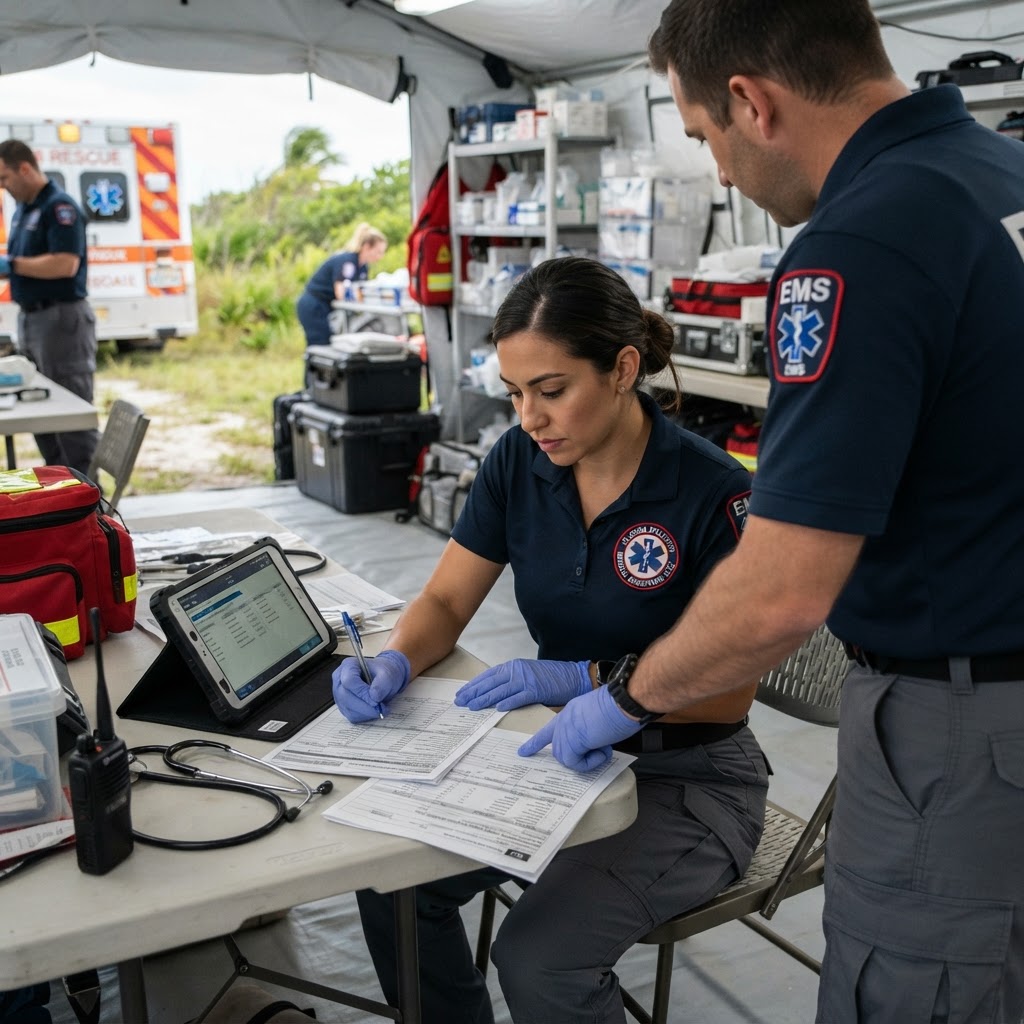
In the high-stakes environment of disaster response, the focus is often on the immediate interventions: securing the airway, controlling hemorrhage, or navigating complex search and rescue terrain. However, the true mark of a professional responder is the ability to maintain clinical excellence through meticulous documentation. Whether operating in a tented field hospital or a mobile strike team, accurate records serve as the foundation for patient safety and the continuity of care during extended operations.
Why Records Outlive the Shift
Disaster scenes in Florida, ranging from hurricane aftermaths to localized flooding, often involve fragmented systems where patient handoffs are frequent. When a patient moves from a volunteer EMS provider to a regional hospital or another transport agency, the continuity of information is vital. Clear, concise, and objective documentation prevents the loss of critical clinical history. It allows subsequent providers to understand the patient's baseline and the interventions already performed, which is essential when the original treating crew is no longer present.
Standardizing Data in Dynamic Environments
Maintaining documentation standards under pressure is a significant challenge. Responders should focus on capturing the 'who, what, when, and where' with precision. This means recording accurate timestamps for interventions, noting the specific condition of the patient upon arrival, and documenting any changes in status following treatment. Utilizing standardized terminology and avoiding shorthand that might be misunderstood by other agencies ensures that your clinical notes act as a reliable bridge rather than a point of confusion during inter-agency handoffs.
The Legal and Ethical Dimension
Beyond clinical utility, documentation acts as the primary legal record for every patient interaction. In the chaotic wake of a disaster, memory is an unreliable witness. Your patient care report provides the objective evidence of the care provided, reflecting your commitment to professional standards. By focusing on objective findings—what you see, hear, and measure—rather than subjective interpretations, you protect both the patient and your professional integrity as a volunteer responder.
Practical Takeaways
- Focus on objective data: Prioritize measurable vitals and observable physical findings over speculation.
- Ensure clear handoffs: Use the 'I-PASS' or similar structured communication tools to verbalize your documentation to receiving teams.
- Document early and often: Capture critical interventions immediately after they occur to avoid memory gaps at the end of a long shift.
- Verify patient identifiers: In disaster settings where patient records might be sparse, double-check names and DOBs to prevent identification errors.
Why This Matters to ERF
At Emergency Responders of Florida, we pride ourselves on delivering professional-grade care that integrates seamlessly with existing EMS infrastructure. Our volunteers are ambassadors of clinical excellence. By prioritizing accurate documentation, our responders ensure that the care provided by ERF is recognized for its quality, reliability, and professionalism, fostering trust with our state partners and the communities we serve.
Stand Ready With ERF
Florida EMTs and Paramedics can submit a Disaster Reserve interest form to be considered for activation during major emergencies, with no regular hourly requirement.
ERF is not a 911 service. In an emergency, call 911.