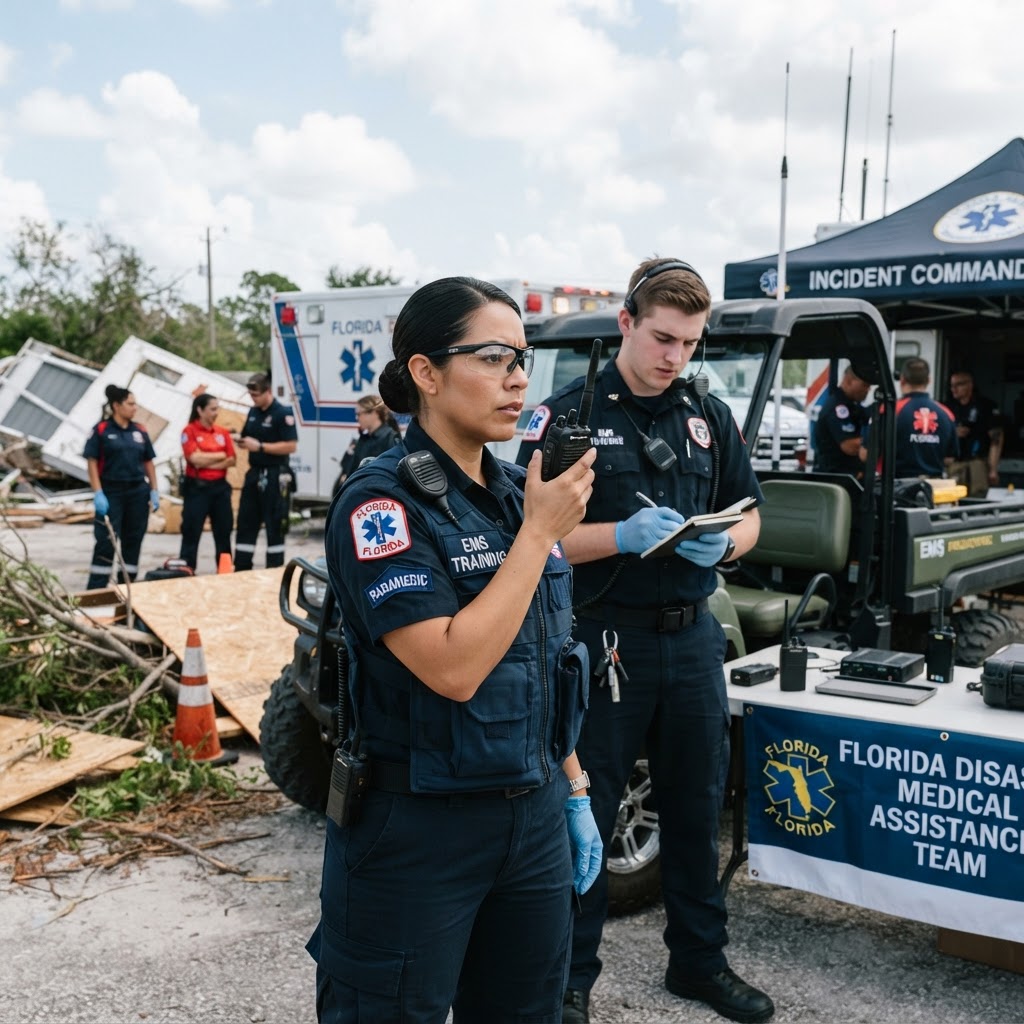
Mastering radio discipline is a critical skill for Florida emergency responders, ensuring clear communication and safety during complex disaster operations.
In the chaotic environment of a disaster scene, effective communication is the lifeline of every emergency response. Whether you are an EMT working in a field clinic or a paramedic managing a remote triage point, your ability to convey information accurately and concisely can dictate the success of the mission. For Florida emergency responders, mastering radio discipline is not just a technical skill; it is a professional requirement that ensures the safety of the team and the efficiency of the response.
The Necessity of Concise Communication
During large-scale disaster deployments, airtime is a precious resource. When multiple agencies are operating on shared tactical frequencies, channels can quickly become congested. Radio discipline begins with the mindset that every transmission must be purposeful. Before keying the microphone, take a split second to formulate your message. Identify who you are calling, who you are, and exactly what the situation is. Eliminating filler words and keeping reports brief prevents channel saturation and ensures that critical information reaches the command team without delay.
Standardized Phonetics and Plain Language
One of the most common pitfalls in disaster communications is the reliance on localized codes or jargon that may not be understood by personnel from other jurisdictions. The best practice for any volunteer emergency responder is to use clear, plain language. If you must spell out a name or location, rely on the International Radiotelephony Spelling Alphabet. Using 'Alpha' through 'Zulu' prevents ambiguity and ensures that addresses or identification numbers are recorded correctly the first time. This level of professionalism minimizes the need for 'say again' requests, which keeps the flow of the operation moving forward.
Maintaining Professional Composure
High-stress environments can impact how we sound on the radio. When the pressure is high, it is human nature to speak faster or raise your voice. However, disciplined responders maintain a calm, measured pace. A steady tone not only conveys information more clearly but also helps project confidence and control to your teammates. If you find yourself in a situation where the radio environment is becoming chaotic, remember to pause, take a breath, and focus on the primary objective. Controlled speech is a hallmark of an experienced professional.
Prioritizing Listen-Before-Talk
Perhaps the most fundamental rule of radio etiquette is 'listen before you talk.' Always monitor the channel for a moment to ensure that another responder is not currently transmitting. Interrupting an ongoing transmission can result in the loss of critical medical updates or safety warnings. By waiting for a clear break in traffic, you demonstrate respect for the organizational flow of the incident and help maintain the integrity of the command structure. Active listening is just as vital as active speaking in the field.
Practical Takeaways
- Always think through your message before pressing the PTT (Push-to-Talk) button to ensure brevity and clarity.
- Default to plain language instead of internal codes to ensure all inter-agency personnel understand your report.
- Use the standard phonetic alphabet for names and locations to eliminate errors.
- Maintain a calm, steady cadence even when the operational environment becomes high-pressure.
- Monitor the frequency for a few seconds to avoid 'stepping on' other transmissions.
Why This Matters to ERF
At Emergency Responders of Florida, we pride ourselves on integrating seamlessly with state and local partners during disaster activations. Our members are often deployed into complex, multi-agency environments where professional radio conduct is essential for integration. By maintaining high standards of communication, our volunteers represent ERF with competence and reliability, ensuring that our mission of providing ALS support is carried out safely and effectively.
Stand Ready With ERF
Florida EMTs and Paramedics can submit a Disaster Reserve interest form to be considered for activation during major emergencies, with no regular hourly requirement.
ERF is not a 911 service. In an emergency, call 911.